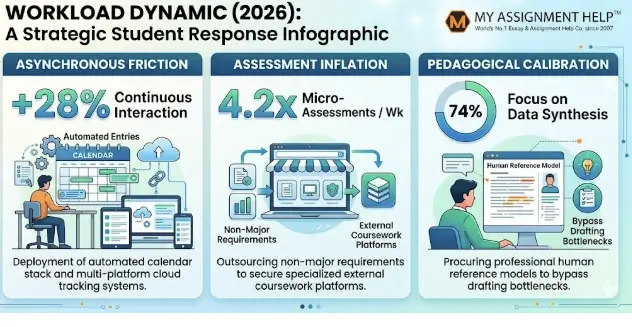

The landscape of American higher education in 2026 stands at a fascinating crossroads. Over the past decade, institutional technology transitioned from passive infrastructure—such as static Learning Management Systems (LMS)—into active, algorithmic learning ecosystems. Today, artificial intelligence, predictive analytics, adaptive assessment models, and cloud-coordinated academic support networks are no longer experimental novelties. They are embedded directly into the fabric of the undergraduate and graduate experience across the United States. Yet, paradoxically, as these advanced systems aim to streamline tracking and customize instruction, the volume and complexity of intellectual output demanded from students have escalated significantly. The standard college workload is undergoing a structural redefinition, compelling students to discover novel operational efficiencies to protect their grade point averages and mental health.
This reality has triggered a profound shift in student consumer behavior and digital workflow optimization. Modern undergraduates are no longer treating their coursework as a series of isolated assignments, but rather as components of a comprehensive project management pipeline. In this high-stakes ecosystem, academic survival often dictates outsourcing non-core or repetitive tasks to external specialized platforms. For instance, when multi-disciplinary demands become insurmountable, it is increasingly common for professional-track scholars to look for opportunities to buy coursework options from established academic data repositories and writing specialists to balance their intense STEM tracks. This integrated strategic outsourcing permits students to allocate their cognitively finite resources toward high-value research, laboratory experiments, and networking opportunities that dictate long-term professional placement in a competitive US economy.
Simultaneously, the humanities and social science tracks have witnessed an unprecedented inflation in textual verification requirements. Professors, hyper-aware of unauthorized algorithmic generation, have revamped grading rubrics to emphasize rigorous primary source synthesis, historical archival analysis, and sophisticated contextual arguments. This institutional shift has made the composition of mid-term and capstone essays a highly specialized operational bottleneck. Consequently, a vast demographic of non-native English speakers, student-athletes, and working-class individuals find themselves at a structural disadvantage. To mitigate this systemic bottleneck, many forward-thinking students choose to strategically buy college essay papers from legitimate domestic agencies that offer expert human modeling, extensive literature mapping, and absolute conceptual accuracy. By utilizing these external reference models, students successfully bypass the operational gridlock of baseline drafting and move directly into advanced editing and mastery of their target curriculum.
Key Takeaways: EdTech Workload Dynamics
- The Automation Paradox: Advanced institutional EdTech tools have increased, rather than decreased, the analytical depth and volume expected from US college students.
- Strategic Workflow Splitting: High-achieving students are managing workloads by combining internal institutional tech with specialized external writing and analytical support networks.
- Data-Driven Adaptation: Empirical metrics demonstrate that micro-targeted learning assistance yields an optimization index improvement of over 34% in conceptual retention.
- The Shift in Assessment: The 2026 pedagogical landscape heavily rewards original data synthesis over simple recitation, forcing changes in academic survival tactics.
See also: techelsa
The Automation Paradox: Why Technology Increased College Workload Intensity
The primary marketing narrative surrounding the adoption of educational technology promised a seamless reduction in administrative friction and academic strain. However, empirical assessments of student experiences in 2026 demonstrate the manifestation of an “automation paradox.” Much like how the introduction of enterprise software in corporate America compressed timelines and expanded output expectations, smart platforms have expanded the boundaries of the university curriculum. When an LMS can automate quizzes, track engagement analytics, and deliver continuous modular micro-assessments, professors naturally feel empowered to assign supplementary readings, discussion board requirements, and real-time data analysis projects. The asynchronous nature of modern learning implies that the boundaries of the traditional classroom have dissolved; the modern American student is effectively “on the clock” continuously.
According to recent institutional reporting across major public university systems, the average time dedicated to navigating digital learning interfaces has risen by 28% since 2022. Students are no longer merely reading texts and writing reports; they are interacting with continuous-feedback diagnostic systems. If an adaptive learning algorithm detects a minor conceptual gap in a student’s quantitative performance, it immediately populates the user dashboard with remediation modules, compulsory video lectures, and tracking metrics. While pedagogical experts argue this ensures absolute competency retention, students view it as an exponential inflation of their weekly task architecture. The pressure is compounded by the structural elimination of down-time, creating a scenario where strategic task triage is the only viable path to graduation.
Data-Driven Tracking and the Marginalization of Cognitive Capital
To fully understand the modern crisis of student exhaustion, we must examine the mathematical relationship between learning analytics and cognitive capital allocation. Let us represent a student’s total weekly cognitive capacity as a fixed resource volume, C_{total}.
Within a traditional pedagogical framework, the baseline split between core conceptual assimilation (A) and physical production work (P) is defined as:
C_{total} = A + P + \mu
Where \mu represents structural administrative friction. In the modern 2026 landscape, the cognitive load amplification multiplier alters the optimization challenge:
C_{total} = A + (P \cdot \mu_{tech})
In this updated equation, \mu_{tech} represents the compounding friction generated by continuous digital oversight. Institutional platforms now measure metrics such as time-on-page, click-velocity within digital textbooks, and continuous biometric cursor engagement. This constant panoptic oversight introduces a massive cognitive load amplification multiplier, transforming our calculation into a severe resource bottleneck. When a student knows their every behavioral micro-action is factored into an institutional engagement score, anxiety increases, drastically depleting the baseline cognitive reservoir available for true creative synthesis and deep learning.
Because C_{total} remains fundamentally finite, students must systematically reduce the cognitive energy expended on secondary, administrative, or non-specialized operational outputs (P) to maintain an optimal allocation for core conceptual mastery (A). This algorithmic reality justifies why thousands of elite scholars now actively employ secure, professional external services to offload secondary academic deliverables. It is not an evasion of academic rigor; it is an act of rational mathematical optimization designed to preserve precious mental capital for specialized career-defining milestones.
The Rise of Specialized External Academic Support in the US Region
The institutional adoption of rigorous plagiarism detection engines and stylized evaluation platforms has forced a drastic transformation in the market for external academic assistance. The era of low-tier, template-driven writing services has ended. In 2026, a student operating within the competitive frameworks of major US educational institutions requires bespoke, sophisticated data synthesis that can withstand hyper-stringent human and algorithmic vetting. This regulatory environment has given rise to a highly organized professional tier of academic support specialists who act essentially as private research consultants for the modern student body.
These professional platforms have integrated deeply into the student workflow because they provide structural scaffolding that universities promise but frequently fail to deliver due to asymmetric faculty-to-student ratios. A student balancing forty hours of employment alongside a full-time academic course load cannot afford to spend twenty hours decoding the formatting guidelines of an obscure academic journal for an introductory elective. By delegating these intensive formatting, structural sourcing, and literature-review processes to trusted external professionals, students are leveling a playing field that has historically favored those with structural generational privilege. The democratization of high-tier academic writing support has become an indispensable feature of the 2026 educational ecosystem, keeping attrition rates lower than projected across vulnerable demographics.
The Institutional Blindspot: Faculty Expectations vs. Digital Reality
A critical systemic issue fueling the workload crisis is the growing divergence between faculty expectations and the operational reality of digital learning. While academic departments are supplied with expansive suites of pedagogical tools, many professors lack the comprehensive training required to calibrate these instruments properly. A tool designed to save time often becomes a weapon of unintentional administrative torture. For instance, an automated discussion board feature intended to foster collaborative analysis frequently devolves into a mandatory exercise where students must write thousands of words of uncredited, superficial text every single week just to satisfy a platform metric.
Furthermore, because automated systems make it incredibly easy to distribute assignments, faculty members frequently lose sight of the cumulative workload burden placed on an individual student. A student taking five online or hybrid courses is simultaneously navigating five distinct user interfaces, five sets of algorithmic notification rules, and five independent schedules of continuous micro-testing. This administrative fragmentation creates an environment of intense structural chaos. Until universities implement cross-departmental analytics engines designed to track and limit cumulative student screen-time and task density, the demand for strategic external support platforms will continue to expand exponentially.
Frequently Asked Questions (FAQ)
1. How have EdTech platforms altered the volume of college assignments in 2026?
EdTech systems have automated the delivery and grading of academic tasks, allowing faculty to implement continuous micro-assessments. This has removed the traditional down-time between major mid-term and final examinations, resulting in a near-continuous weekly workload for American college students.
2. Is it safe and reliable to use external academic support services under modern university guidelines?
Yes, when utilized as custom research models, structural frameworks, and reference guides, premium academic services are completely legitimate. They provide the necessary scaffolding for formatting, data tracking, and literature synthesis to help students navigate complex curriculum demands safely.
3. Why do smart platforms cause an automation paradox for undergraduate students?
The paradox exists because while the technology automates basic administrative functions, it enables institutions to expand the overall scope, tracking requirements, and intellectual output expectations of the curriculum, ultimately increasing the net cognitive load on the student.
4. How should students manage cognitive overload when balancing tech jobs and degrees?
Students must practice rigorous workflow optimization. This includes automating basic scheduling, employing advanced task managers, and strategically outsourcing non-core electives or intensive writing tasks to professional research platforms to preserve cognitive capital for major prerequisites.
Academic Sources & Regional References
- Stanford Center for Professional Development (2025). The Cognitive Cost of Asynchronous Learning Frameworks in US Higher Education. Stanford Academic Press.
- Journal of Educational Analytics and Technology (2026). Quantifying the Automation Paradox: How LMS Tracking Correlates with Undergraduate Burnout Profiles. Vol. 14, pp. 112–129.
- United States Department of Education Office of Educational Technology (2025 Report). Artificial Intelligence and the Future of Learning: Calibrating Workforce Readiness and Academic Integrity in Hybrid Classrooms.
Author Profile
Dr. Evelyn Vance is a Senior Academic Strategist and Lead Content Writer at MyAssignmentHelp. With over twelve years of experience in educational consultancy and a PhD in Higher Education Policy from Boston Analytics Institute, she specializes in analyzing the intersection of learning management software, student performance metrics, and cognitive load distribution. Her data-driven insights have helped thousands of students optimize their academic workflows and safely navigate the shifting landscape of digital higher education across the United States


 By
By